The Latest Hot Air Tool Resources

Leister Extruder Comparison: Which One is Right for Your Job?

Posted | 0 Comments

Leister extruders offer a range of material output and heat capacities, meaning that some extruders are better suited to certain jobs (i.e. container construction, pipeline construction or civil engineering liners) and materials (i.e. PE, PP, PVC, TPO) than others. Picking the right one for your plastic fabrication or civil engineering work isn’t always easy.  

This guide provides an overview of each Leister hand extruder, including intended material use, material output, physical characteristics and continuous operation capabilities. At the end, we provide an easy to scan product comparison table for your reference. 

If you have any questions about Leister extruders contact IHS at 800-635-0384 or info@ihshotair.com.

Leister Extruder Overview

FUSION 2: Built for PE and PP materials, the Fusion 2 offers material output between 2.87 and 3.97 lbs./hr. for a 4mm diameter welding rod. It is perfect for fabrication of objects between 0.23 and 0.59 in. thick. Its compact size, lightweight, ergonomic construction, rotating welding shoe and double-sided, twist-free wire intake make it ideal for welding at all angles. It’s brush motor means it should not be used on projects that require hours of continuous operation.

FUSION 3: Built for PE and PP materials, the FUSION 3 offers a material output volume between 3.94 and 7.94 lbs./hr. depending on the plastic type and rod thickness. It is intended for plastic fabrication and civil engineering work on materials between 0.31 and 0.98 in. thick. With a long, lean design, it is ideal for comfortable welding in high, low and hard-to-reach areas. Its brush motor also means you should avoid hours of continuous operation.

FUSION 3C: The FUSION 3C is similar to the FUSION 3 in every way except that it is shorter and lighter, making it better suited for general plastic fabrication and civil engineering welds. 

WELDMAX: Built for welding PE, PP, PVDF and PA, the WELDMAX is Leister’s smallest extruder at just 3.8 lbs. and 17 in. long. It is designed for light plastic fabrication of thin-walled materials (between 0.16 and 0.39 in.). It offers a material output up to 1.76 lbs./hr., and its brush motor makes it better suited for short work periods. 

WELDPLAST S2: Designed to weld PE and PP, the WELDPLAST S2 is a lightweight, compact, ergonomically designed tool ideal for welding in confined areas or at odd angles. This extruder has a material output between 1.1 and 5 lbs./hr. depending on the material type and rod thickness. This makes it ideal for work on civil engineering and plastic fabrication applications where the material thickness ranges between 0.15 and 0.79 in. Its brushless motor allows for worry-free, continuous operation. 

WELDPLAST S2 PVC: Identical to the WELDPLAST S2, the WELDPLAST S2 PVC is optimized for plastic fabrication welds with PVC-U, but can also be used to weld PE and PP. 

WELDPLAST S2 TPO: Again, identical to the WELDPLAST S2, the WELDPLAST S2 TPO is optimized for welding civil engineering membrane seams made of TPO material. 

WELDPLAST S4: Intended for welding PP and PE materials, the WELDPLAST S4 is a powerful hand extruder capable of outputting between 3.3 and 8.8 lbs./hr. depending on material type and welding rod diameter. This extruder is Ideal for plastic fabrication and civil engineering applications where material is between 0.31 and 1.38 in. thick. Its compact housing reduces noise and keeps components cool, and a brushless motor allows for hours of continuous operation.

WELDPLAST S6: The most powerful Leister hand extruder, the WELDPLAST S6 offers a material output of between 8.59 and 13.23 lbs./hr. depending on the material (PE or PP) and welding rod diameter. Even though it is the heaviest (30 lbs.) and longest (32 in.) Leister extruder, its unique, control-wheel grip and ergonomic design allow for comfortable welding. It is ideal for work on materials ranging in thickness from 0.59 to 1.57 in., and its brushless motor allows for hours of continuous operation.

Detailed Extruder Breakdown

               
Plastic Material  HD-PE, PP HD-PE, PP HD-PE, PP  HD-PE, PP, PVDF HD-PE, PP, PVC HD-PE, PP  HD-PE, PP
Welding Machine FUSION 2 FUSION 3 FUSION 3C WELDMAX  WELDPLAST S2 WELDPLAST S4 WELDPLAST S6
Container Construction Yes Yes Yes Yes Yes Yes Yes
Pipeline Construction Yes Yes Yes No Yes Yes Yes
Landfills / Civil Engineering No Yes No No No Yes Yes
PERFORMANCE
Voltage  230  230  230  120/230  230  230  230
Power  2800  3500  2800  1800/2200  3000  2380  4600
Welding Wire (mm) 4  3-5  3-5  4  3, 4  3, 4  4, 5
Output (lbs./hr.) 2.7 - 4  4 - 7.9 4 - 7.9  0.7 - 1.8  1.3 - 5.1  3.3 - 8.8  8.6 - 13.2
Material Thickness (in.) 0.23 - 0.59 0.31 - 0.98 0.31 - 0.98  0.15 - 0.39  0.15 - 0.79 0.31 - 1.38 0.59 - 1.57
Size (LxWxH) (in.) 17.7 x 3.9 x 8.9  26.4 x 3.5 x 7.1  23.1 x 3.9 x 8.9  17.4 x 3.7 x 10  17.7 x 3.9 x 10.2 22.1 x 4.3 x 11.8  32.3 x 4.6 x 9.6
Weight (lbs.)  13  15.87  15.21  8.38  12.79  19.18  30.86
FEATURES
Digital Display No No No Yes  Yes  Yes  Yes
Motor Startup Protection Yes Yes Yes No No No No
Twist-Free Wire Intake Yes Yes Yes No No Yes Yes
360° Rotating Welding Shoe Yes Yes Yes No Yes No No
Steplessly Adjustable Temp. Yes Yes Yes Yes No No No
Brushless Blower Motor No No No No Yes Yes Yes


If shopping for a Leister hand extruder, ask yourself the following 4 questions before making an extruder purchasing decision.

If you have any questions about Leister hand extruders, please contact IHS’ Leister-certified experts at 800-635-0384 or info@hy-techroof.com


Leister Welder Portable Generator Considerations

Posted | 0 Comments

Power supply plays a huge role in a Leister hot-air welder’s performance and life. Inconsistent power supply from a portable generator will cause the welder’s performance to suffer and can damage internal electrical components, rendering the tool useless.

In this post, we’ll take a look at what inconsistent power looks like, its effects and what to look for in a portable generator.

What Inconsistent Power Looks Like

Alternating Current, or AC, gets its name because the electricity flow alternates back and forth between positive and negative, creating a sine wave (as seen below). In ideal conditions, this sine wave is a smooth line that flows up and then down consistently over a specific time interval.

Source: Associated Power Technologies

However, many factors can cause inconsistencies, which appear as spikes or valleys on the sine curve. These inconsistencies are known as harmonic distortions.

Power supply consistency is measured in total harmonic distortion—the average percentage a portable generator’s AC flow differs from what it would be under ideal conditions.

The larger and more frequent the inconsistencies, the higher the total harmonic distortion percentage.

What Power Inconsistency Means to Leister Hot-Air Welders

These electric current spikes and valleys can negatively impact your Leister welder’s performance, and even damage internal electrical components.

  • Valleys represent a decrease in electricity flow, which limits the amount of electricity entering the welder. While sporadic, small valleys won’t result in any noticeable effects, large, sustained valleys will cause decreased temperature and airflow despite the welder’s setting, which can translate into a weak weld.
  • Spikes represent electrical surges that flow into your welder. Large surges, or small-to-medium surges over an extended period of time, begin to overheat and damage internal components, like a heating element or control panel. This can shorten the component’s life or, if the spikes are big enough, short out and melt these parts immediately.  

Leister welders with digital displays and control interfaces, like the VARIMAT V2, are often more prone to damage as a result of power inconsistencies because their internal electrical components are more advanced. However, other tools, like the BITUMAT B2 or TRIAC S, can also suffer from power inconsistencies.

What to Look For in a Portable Generator

If you use a portable generator and your Leister hot-air welder regularly sustains damage to heating elements or internal electrical components, or you experience inconsistent weld quality, it may be time to consider a new portable generator.

NOTE: Please speak to an IHS Leister-certified technician before purchasing a portable generator, because inconsistent power may not be the actual cause of your welder’s issues.

Most manufacturers will publish their portable generator’s total harmonic distortion on sales collateral and/or its website. When shopping for a new generator, ask for this percentage for both when the generator is running idle and under full load (all power outlets in use).

The IEEE Standard 519 recommends that computer-controlled equipment, and any allied equipment, such as programmable controllers, use an AC power source with no more than 5% harmonic voltage distortion, with no single harmonic being more than 3%.

While portable generators with lower total harmonic distortions may cost more in the short term, replacing damaged welder components or ripping up and repairing poorly welded roofing systems, pond liners, landfill liners or large signage, can end up costing more in the long term.

If you have any questions regarding portable generators, contact IHS’ certified Leister representatives at 800-635-0384 or info@ihshotair.com.

If you are in the market for a new portable generator, our sister company—Hy-Tech Products—offers its own line of portable generators. These generators were designed specifically to operate Leister welding equipment and tools. They operate at 5% total harmonic distortion while idling and 3% under a full load.

How to Repair a Billboard Seam with Leister Hot-Air Tools

Posted | 0 Comments

Billboards are commonly made from tough, weather-resistant plastic membranes because they are often outdoors and exposed to environmental conditions, like wind, rain, snow and direct sunlight. 

While there are several ways to seam the billboard’s plastic sheets, many manufacturers choose to hot-air weld because this method creates a permanent bond between the sheets, versus simply holding the sheets together, as is the case with stitching, glue or tape.

However, if not done properly, hot-air welds can weaken and form gaps or voids over time and with heavy weathering. When this happens, you’ll need to repair these gaps to avoid further damage to the billboard.

In this post, we’ll detail what hot-air welding tools you’ll need, and then outline the steps to repair any billboard seam damage.

Plastic Welding Tools You’ll Need

Before you begin, make sure you have the following tools and accessories at the ready.

  • Hot-air hand tool: A hot-air hand tool, like the Leister TRIAC S, is a lightweight, handheld portable heat source that gives you freedom and flexibility when it comes to welding position, angle and height.

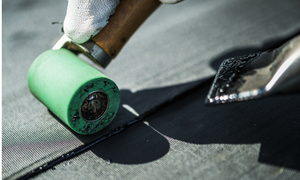
  • Pressure roller: A hand pressure roller is rolled over the heated fabric sheets to force the semi-melted seam surfaces together and create a strong bond.

  • Overlap nozzle: An overlap nozzle is a thin but wide attachment for your hot-air hand tool that allows for the effective delivery of hot air between the overlapping sheets of material.

  • Scrap material: Always have a length of scrap material that is identical in terms of plastic type and thickness to the billboard’s material. Environmental conditions will impact how much heat exposure and pressure are required to ensure a strong weld. The scrap material is used to practice your weld before performing it on the actual billboard.

  • Seam probe: A roof seam probe is used to test weld consistency after the repaired seam has had time to cool. Using a seam probe helps you identify any accidental gaps or voids.

How to Repair the Billboard Weld Seam

  1. Make sure the billboard can be pressed against a hard, flat surface. Without this surface, it will be difficult to generate the pressure necessary to create a strong bond. If one is not available, it may be necessary to take down the billboard to repair it.

  2. Clean the seam surface. Make sure to remove any moisture, dust, dirt or other contaminants. These may affect the material’s ability to weld, and potentially compromise the strength of the weld.

  3. Attach the overlap nozzle to your hot-air hand tool by pushing it onto the end, and make sure it is snuggly in position before turning on the tool. With some types of nozzles, you may need to tighten the fastening screw on the nozzle to secure it to the tool.

  4. Turn on your hot-air hand tool. Adjust the temperature setting to what you believe is necessary to properly weld your material. The required temperature will be based on:

    • The ambient temperature of your work area
    • How much sunlight the membrane is exposed to
    • Moisture (i.e. humidity, dampness)
    • The type of material you’re welding
    • The material’s thickness
  5. After your hot-air hand tool has had time to warm up (approx. 5 minutes), perform a test weld on your scrap material to make sure you have the proper temperature setting and welding technique.

    To quality test your test weld, let the seam cool for 10-15 seconds, and then rip the pieces apart. With a good weld, part of the welded material will be stuck to the other piece, and you will see the material's scrim.

  6. Make sure the final billboard material is as taut as possible without stretching. This will ensure the graphics align properly, and help to avoid wrinkles in the weld.

  7. Slip the overlap nozzle between the gap in the two sheets and allow the hot air to heat up the material for several seconds.

  8. Place the pressure roller near the end of the nozzle between the fabric. Press the heated material sheets together against the flat surface. Move the welder nozzle around to all parts of the seam gap, continuing to roll the pressure roller directly on the heated area. 

  9. When complete, give the area 10 to 15 seconds to cool, and then run the seam probe along the welded seam edge to check for any gaps or voids. If any are detected, re-weld that area as needed.

If you have any questions or are interested in learning more about the proper Leister tools for billboard repairs, please contact IHS at 800-635-0384 or info@ihshotair.com.

How to Replace the Carbon Brushes in a Leister ELECTRON

Posted | 0 Comments

The ELECTRON is Leister's most powerful hot-air hand tool. It is perfect for welding different types of plastic materials, modified bitumen, drying and removing coatings

The ELECTRON’s motor includes two carbon brushes. These brushes are used to transfer electricity from the outside of the motor to the spinning winding, or commutator. 

Each carbon brush is attached to a spring (see right) to keep it pressed against the commutator; some also have a small carbon disk at the other end of the spring to support conductivity.

Carbon is used because it is soft enough not to wear down the commutator and still offers good conductivity. The tradeoff is that these brushes wear out with regular use, and will need to be replaced. 

When carbon brushes are worn out, your ELECTRON may:

  • Turn off and on while being used.
  • Make a banging sound.
  • Start to smoke or spark. 

If any of these are happening, check that the carbon ends of the brushes aren't worn down. If they are, replacing the brushes should resolve these symptoms.

The following steps explain how to find, remove and replace the brushes in your Leister ELECTRON hand tool. If you need replacement brushes or require support for your tool, please contact IHS at 800-635-0384 or info@ihshotair.com.

Find the Leister ELECTRON’s Brushes


Note: Before performing any maintenance on your ELECTRON hot-air hand tool, be sure the tool is completely cool to the touch, the power is turned off and the tool is unplugged.

1. First, peel back the ribbed, black rubber ring that wraps around the tool just above the top of the green handle, and slide it off the tool. 

2. Remove the 2 screws located under the green casing lip using a flathead screwdriver.

3. Slide the green handle casing off the tool and over the power cord. The tool’s motor should now be exposed.

4. Once the motor is exposed, locate the brushes by looking for a brushed copper flap (or door) located around the middle of the motor body. There should be another copper flap on the opposite side. The brushes are located under these flaps.

Remove and Replace the ELECTRON's Brushes

5. Choose a door and carefully pry it open with a flathead screwdriver to reveal a brush. When you pry open the door, the spring will pop out.

6. Grasp the end of the spring and pull out the old carbon brush. Avoid pulling hard because the spring can come loose. If the brush is stuck, pry back the door more to give it additional clearance.

7. Once the worn carbon brush is removed, insert the replacement brush. The brush is rectangular and the thin ends should face both ends of the tool. 

8. Compress the spring on the brush while simultaneously closing the door. Remember: Patience is a virtue.  

9. Repeat these steps on the other side of the hot-air hand tool.

10. Once both brushes are properly replaced, slide the green handle casing back over the tool’s exposed motor, and reattach it by tightening the two screws you removed in Step 2.

11. Finally, slide the rubber ring back over the tool, and align the ring's interior rib with the groove between the black and green parts of the heat gun. 

Please Note: When you turn the hot-air gun on again, you may hear a small clunking sound while the carbon brush conforms to the shape of the commutator. This is normal, and shouldn't last long. 

If you need replacement brushes or support for your Leister ELECTRON hot-air hand tool, contact IHS’ Leister-certified technicians at 800-635-0384 or info@ihshotair.com. 

4 Questions to Ask Before Buying a Hand Extruder

Posted | 0 Comments

Used in civil engineering and plastic fabrication projects, hand extruders are highly effective plastic-welding tools designed to create strong, durable seam welds.

As with most other Leister tools, the company’s extruders offer a range of material output and heat capacities, meaning that different extruders will perform better for some projects and plastic materials than others.

In this post, we’ve outlined the questions to expect when you’re looking to purchase a Leister hand extruder, and how your answers may impact tool suggestions.

1. What type of plastic material(s) are you working with?

Different materials and thicknesses require different levels of heat exposure for proper welding results. For example, under ideal conditions PE has a melt temperature of approximately 260°F, while PVC’s is about 320°F.

Each Leister extruder is designed to work with specific material types to ensure fast, effective welds. Working with a certified Leister representative can help you accurately narrow down your product options based on the material(s) you commonly work with.

If you work with multiple plastics, you’ll want an extruder with a programmable interface that enables you to program heat and material output settings based on the material type. In Leister’s line of extruders, several include pre-configured temperature and material settings for specific plastic types.

2. How will you use the extruder?

Different applications demand different capabilities out of an extruder. For example, a thin PVC pond liner seam won’t require as much preheat time before applying the extruded material as would a plastic storage box, which will take longer to preheat because of its thickness.

Some Leister extruders are designed for fast operation on thin materials, while others are designed to heat up and operate more slowly, on thicker plastics. A Leister representative can help you find the right extruder for your common usages, helping you to avoid poor seam welds, and big messes.

3. What size space will you be working in?

Space restriction is also an important factor to consider when purchasing an extruder, as Leister’s tools come in a variety of sizes. For example, if you’re welding in a narrow tunnel, an extruder like the FUSION 2 may be better than the FUSION 3 because of its shorter length.

4. How long do you expect to continuously operate the extruder?

Frequent use—for example, in a factory setting where your team welds storage box seams 24 hours a day—places certain demands on an extruder’s motor. For continuous operation, you’ll need an extruder with a brushless motor because they tend to be more durable with constant operation.

However, if your extruder will be used for repair work, or for short intervals throughout the day, an extruder that has a motor with brushes may be a suitable option. These tend to be less expensive than their brushless counterparts. 


If you have any questions about purchasing an extruder, please share them in the comments below, or contact one of our Leister certified representatives at 800-635-0384 or info@ihshotair.com.

Replacement Leister Extruder Heating Elements and Order Numbers

Posted | 0 Comments

Over time and with regular usage, your Leister extruder’s heating element can wear out or break down. When this happens, the element may fail to heat up as it once did or burn out entirely.

If your heating element malfunctions or breaks, it must be replaced. To simplify your search for a replacement element, we have built a list of extruder heating elements and their order numbers.

To find the appropriate replacement heating element for your tool, you’ll need to know its volt and wattage requirements (e.g. 120V / 1600W). Find this on the manufacturer’s label located on the body of the extruder.

To order a replacement Leister Heating Element, contact one of IHS’ Leister-certified technicians at 800-635-0384 or info@ihshotair.com.

FUSION 2 heating elements

  •  230V / 1750W — Order No: 123.561


FUSION 3 heating elements

  •   230V / 1100+1100W — Order No: 113.268


FUSION 3C heating elements

  •   230V / 1750W — Order No: 123.561


WELDMAX heating elements

  •   230V / 1400W  — Order No: 112.638
  •   200V / 1400W — Order No: 112.962
  •   120V / 1150W — Order No: 112.963


WELDPLAST S2 heating elements

  •   230V / 1100+1100W — Order No: 109.984


WELDPLAST S2 PVC heating elements

  •   230V / 1100+1100W — Order No: 109.984


WELDPLAST S4 heating elements

  •   230V / 1100+1100W — Order No: 109.984


WELDPLAST S6 heating elements

  •   230V / 1300+1300W — Order No: 134.567


If you need to order a replacement element or if you cannot find your element here, contact one of IHS’ Leister-certified technicians at 888-561-6096 or info@ihshotair.com.

How to Replace the HOT JET S Heating Element

Posted | 0 Comments

When your Leister HOT JET S fails to generate the necessary amount of heat, the probable cause is the tool’s heating element has gone bad.

One quick visual inspection for this is to turn the red potentiometer dial to 10, and holding the tool as far away from your face as possible, see if the end of the heating element is fully glowing. If it is not, or only half is glowing, it will need to be replaced. 

To find order numbers for a replacement heating element, see our complete list of replacement hand tool heating elements.

Follow the steps below to remove, inspect and replace the heating element in your HOT JET S.

Before You Begin

To avoid accidental burns, make sure the HOT JET S has had a chance to completely cool down (even if it doesn’t appear to be heating properly).

Start by turning the red temperature potentiometer to 0, while turning the black air volume potentiometer to 10. This will blow cool air through the heating element, gradually cooling it down. 

Once the tool’s heater tube is cool to the touch (approx. 5 mins.), turn the black potentiometer to 0, and then turn off the tool with the power switch. Now, you are ready to take apart your HOT JET S.

How to Remove and Inspect the Heating Element

1. Remove the heater tube’s mounting screws. Using a flat-head screwdriver, remove the 3 mounting screws that attach the heater tube to the tool’s handle.

Note: The screws don't need to come all the way out, they just need to be loose enough that the black ring at the bottom of the heating element tube comes loose from the rest of the heat gun.  

2. Expose the heating element. Pull the heater tube straight up and set it aside. This will reveal the mica tube. Remove it and set it aside, as well. 

3. Take off the heating element. Firmly grip the cool heating element with one hand, while gripping the tool’s handle in the other. Gently rock the heating element back and forth until it pulls free from the tool.

4. Inspect the heating element for cracks and/or burn marks. Also, check the element’s air inlet (the white end of the element that plugs into the tool) for blockages, such as lint or other particles. A blockage may cause the element to burn out or malfunction. 

How to Replace the Heating Element on the HOT JET S 

If your heating element is burned out or clogged and you’ve purchased a replacement, or if you need to reattach the existing one, use the following instructions to secure your heating element to the HOT JET S. 

  1. Plug the new heating element into the tool’s handle. Align the heating element’s two prongs with the socket holes. Press firmly together and make sure it is completely seated before moving on to the next step.
  2. Slide the mica tube back over the heating element. 
  3. Reattach the heater tube last. When sliding the heater tube in place, make sure the 2 prongs on the bottom of the black ring align with the 2 guide holes on the tool handle. Next, retighten the 3 fastening screws. 

If you have trouble locating a replacement element for your HOT JET S hand tool or replacing the heating element did not solve the problem, please contact IHS at 800-635-0384 or at info@ihshotair.com

Replacement Leister Process Heater Heating Elements and Order Number

Posted | 0 Comments

If you’re experiencing heating issues with your process heater—such as not reaching set temperatures, or not getting any heat from the unit at all—it’s likely that its heating element needs to be replaced.

To find the appropriate replacement heating element for your heater, you’ll need to know the following details, all of which can be found on the product label located on the heater’s casing:

  • Volt and Wattage Requirement (e.g. 120V / 1600W) — Every Leister process heater is rated for a specific voltage and wattage.
  • Classic, Premium and System — Many of the Leister heaters come in three models—Classic, Premium and System—which correspond to control capabilities. In some cases, the Classic versions of these heaters require a different heating element than the Premium and System versions.
  • S or L — In addition to Classic, Premium and System, Leister heaters can also be distinguished as having either a short (S) or long (L) heating element. Long heating element heaters are designed to offer greater heat output at higher air speeds.

To order a replacement Leister heating element, contact one of IHS’ Leister-certified technicians at 800-635-0384 or info@ihshotair.com.

Click on your Leister process heater below to view heating elements and order numbers for the tool:

Please Note: If you are looking for a heating for the following tools, please contact IHS directly, as heating element options tend to be a bit more complex— LE 700; LE 3,000; LE 3,300; LE 5,000 S, DF and HT; LE 10,000 S, DF and HT; or LE 40,000.

LE MINI

LE MINI heating elements (with close-air channel)

  • 230V / 800W — Order No: 115.679
  • 230V / 400W — Order No: 115.680
  • 120V / 400W — Order No: 115.681

LE MINI SENSOR and SENSOR KIT heating elements

  • 230V / 800W — Order No: 115.364
  • 230V / 400W — Order No: 115.372
  • 120V / 400W — Order No: 115.373

LHS 15

LHS 15 heating elements

  • 230V / 770W — Order No: 139.063
  • 120V / 550W — Order No: 138.110

LHS 20

LHS 20S Classic, Premium and System heating elements

  • 230V / 2000W — Order No: 117.589
  • 230V / 1000W — Order No: 117.585
  • 200V / 2000W — Order No: 117.588
  • 200V / 1000W — Order No: 117.583
  • 120V / 2000W — Order No: 117.587
  • 120V / 1000W — Order No: 117.582

LHS 20L Classic, Premium and System heating elements

  • 230V / 3300W — Order No: 123.213
  • 200V / 3300W — Order No: 123.216

LHS 21

LHS 21 heating elements

  • 230V / 3300W — Order No: 123.213
  • 230V / 2000W — Order No: 117.589
  • 230V / 1000W — Order No: 117.585
  • 120V / 2000W — Order No: 117.587
  • 120V / 1000W — Order No: 117.582

LHS 40

LHS 40S Classic, Premium and System heating elements

  • 230V / 4000W — Order No.: 117.595
  • 230V / 2000W — Order No.: 117.593
  • 200V / 4000W — Order No.: 117.594
  • 200V / 2000W — Order No.: 117.592
  • 120V / 2000W — Order No.: 117.591

LHS 40L Classic, Premium and System heating elements

  • 3 x 440V / 4000W — Order No.: 117.601
  • 3 x 440V / 2000W — Order No.: 117.600
  • 3 x 400V / 4000W — Order No.: 117.599
  • 3 x 400V / 2000W — Order No.: 117.598
  • 3 x 230V / 4000W — Order No.: 117.597
  • 3 x 230V / 2000W — Order No.: 117.596

LHS 41

LHS 41S Classic heating elements

  • 230V / 3600W — Order No: 143.613
  • 230V / 2000W — Order No: 143.612
  • 120V / 2000W — Order No: 143.611

LHS 41L Classic heating Elements

  • 400V / 5500W — Order No: 146.174
  • 400V / 4400W — Order No: 143.615
  • 400V / 2000W — Order No: 143.614
  • 230V / 4400W — Order No: 146.164

LHS 41S Premium heating elements

  • 230V / 3600W — Order No: 143.641
  • 230V / 2000W — Order No: 143.640
  • 120V / 2000W — Order No: 143.639

LHS 41L Premium heating elements

  • 400V / 5500W — Order No: 146.175
  • 400V / 4400W — Order No: 143.643
  • 400V / 2000W — Order No: 143.642
  • 230V / 4400W — Order No: 146.165

LHS 41S System heating elements

  • 230V / 3600W — Order No: 143.669
  • 230V / 2000W — Order No: 143.668
  • 120V / 2000W — Order No: 143.667

LHS 41L System heating elements

  • 400V / 5500W — Order No: 146.176
  • 400V / 4400W — Order No: 143.671
  • 400V / 2000W — Order No: 143.670
  • 230V / 4400W — Order No: 146.166

LHS 60

LHS 60S Classic, Premium and System heating elements

  • 3 x 480V / 6000W — Order No.: 117.611
  • 3 x 480V / 4000W — Order No.: 117.610
  • 3 x 440V / 6000W — Order No.: 117.609
  • 3 x 440V / 4000W — Order No.: 117.608
  • 3 x 400V / 6000W — Order No.: 117.607
  • 3 x 400V / 4000W — Order No.: 117.606
  • 3 x 230V / 6000W — Order No.: 117.605
  • 3 x 230V / 4000W — Order No.: 117.604

LHS 60L Classic, Premium and System heating elements

  • 3 x 480V / 16000W — Order No.: 117.628
  • 3 x 480V / 11000W — Order No.: 123.235
  • 3 x 480V / 8000W — Order No.: 117.624
  • 3 x 480V / 5000W — Order No.: 123.221
  • 3 x 440V / 16000W — Order No.: 117.623
  • 3 x 440V / 11000W — Order No.: 123.234
  • 3 x 440V / 8000W — Order No.: 117.619
  • 3 x 440V / 5000W — Order No.: 123.220
  • 3 x 400V / 16000W — Order No.: 117.618
  • 3 x 400V / 11000W — Order No.: 123.233
  • 3 x 400V / 8000W — Order No.: 117.614
  • 3 x 400V / 5000W — Order No.: 123.219
  • 3 x 230V / 10000W — Order No.: 117.613 or 117.612

LHS 61

LHS 61S Classic, Premium and System heating elements

  • 480V / 8000W (all models) — Order No: 145.441
  • 3 x 480V / 6000W (all) — Order No: 142.870
  • 480V / 4000W (all) — Order No: 143.496
  • 3 x 400V / 9000W (all) — Order No: 143.494
  • 400V / 8500W (all) — Order No: 145.440
  • 3 x 400V / 6000W (all) — Order No: 142.089
  • 3 x 400V / 4000W (all) — Order No: 143.493
  • 3 x 230V / 6000W (all) — Order No: 142.869
  • 3 x 230V / 4000W (all) — Order No: 143.492

LHS 61L Classic, Premium and System heating elements

  • 3 x 480V / 16000W (all models) — Order No: 143.506
  • 3 x 480V / 11000W (all) — Order No: 142.868
  • 3 x 480V / 8000W (all) — Order No: 143.505
  • 3 x 400V / 16000W (all) — Order No: 143.504
  • 3 x 400V / 11000W (all) — Order No: 142.084
  • 3 x 400V / 8000W (all) — Order No: 143.503
  • 3 x 400V / 5000W (all) — Order No. 143.502
  • 3 x 230V / 10000W (all) — 142.867
  • 3 x 230V / 8000W (all) — 143.501

LHS 91

LHS 91 Basic Heating Elements

  • 3 x 480 / 40000W (all models) — Order No: 144.825
  • 3 x 480 / 32000W (all) — Order No: 144.824
  • 3 x 400 / 32000W (all) — Order No: 144.823

LHS 91 System Heating Elements

  • 3 x 400V / 32000W (all models) — Order No: 144.461
  • 3 x 400V / 11000W (all) — Order No: 144.460
  • 3 x 230V / 28000W (all) — Order No: 144.459

Contact one of IHS’ Leister-certified technicians at 800-635-0384 or info@ihshotair.com to order a replacement Leister heating element or for support in finding the right element for your process heater. If you do not see your product listed here, please contact IHS.